Case Study · Product Design · CrossFit Games
CrossFit Games Hashtag Wizard
A self-identifying profile feature for CrossFit Games leaderboards, launched alongside the Custom Leaderboard to help athletes personalize how they show up in the Open.
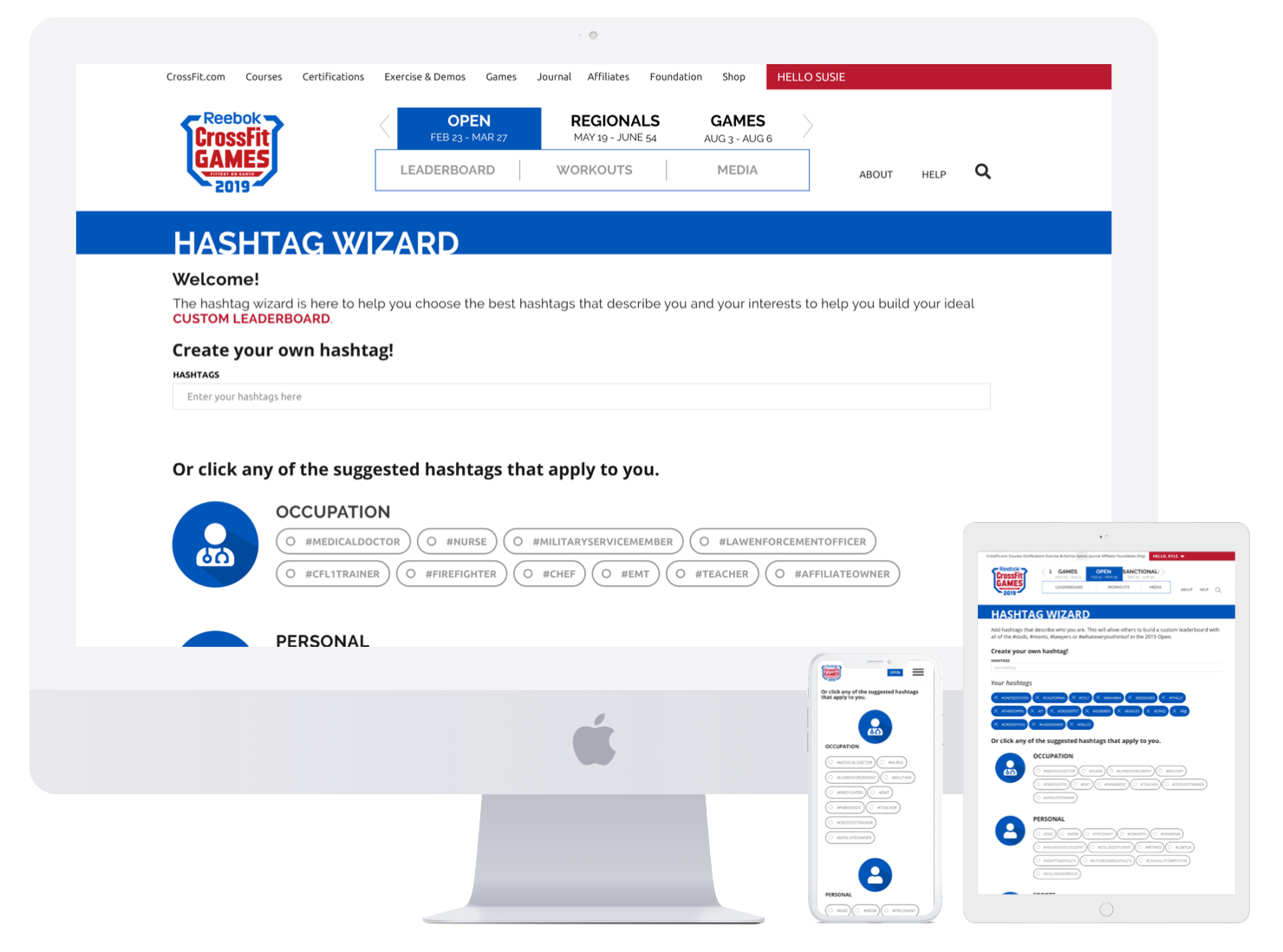
The Hashtag Wizard guided athletes through choosing identifiers that power more personal leaderboards.
Overview
The 2019 CrossFit Open saw the return of Custom Leaderboards, allowing athletes to create leaderboards based on their own interests instead of only traditional filters like overall rank, country, or age group.
To support this, the Games team introduced hashtag integration — giving athletes a way to self-identify using tags that described who they were, what they did, or what they cared about.
The Hashtag Wizard was designed to explain the new feature, showcase examples, and help athletes understand how hashtags would power more meaningful Custom Leaderboards.
Role & Impact
Lead Product Designer
Led the end-to-end UX and UI for the Hashtag Wizard — defining flows, designing layouts across viewports, crafting category badges, and partnering with PMs, stakeholders, and engineers through QA.
Product Context
Layered on Open Leaderboards
Hashtags plugged directly into the existing CrossFit Open leaderboard system, powering Custom Leaderboards driven by athlete-created identifiers.
Design Challenge
Powerful, Not Overwhelming
My Role: Designing a New Social Layer
As the lead designer, I was responsible for helping athletes understand the value of hashtags, guiding them through the wizard, and ensuring the feature felt tightly integrated with the broader CrossFit Games experience.
I owned:
- Defining flows for discovering, selecting, and creating hashtags
- Designing layout and interaction patterns across desktop and mobile
- Creating visual assets, including category badges and “chips”
- Partnering with PMs, stakeholders, developers, and QA to validate behavior
Problem & Context
With hashtag-based personalization being completely new to the CrossFit Games ecosystem, nothing existed yet in product to guide athletes. The first step was to clearly understand:
- What stakeholders wanted the feature to do
- How hashtags would add value to the CrossFit Open leaderboard experience
- Whether athletes needed a guided explanation or would self-discover the behavior
In parallel, the Games and IT teams wanted the 2019 Open to feel more personal and social. Working closely with them, we framed hashtags as a way for athletes to tag themselves — by interests, roles, or attributes they cared about — and then surface those tags in Custom Leaderboards.
Research & Flow Planning
The Hashtag Wizard needed to sit on top of a few key ideas:
- Athletes would manage hashtags inside their profile
- Those hashtags could be used as inputs in the Custom Leaderboard builder
- Hashtags should feel fun and expressive, not heavy or technical
Working from stakeholder input, we started with a massive list of potential identifiers — hundreds of examples of how athletes might describe themselves. Displaying all of them in one place risked overwhelming users, so I grouped them into categories and began exploring layout options based on likely flows.
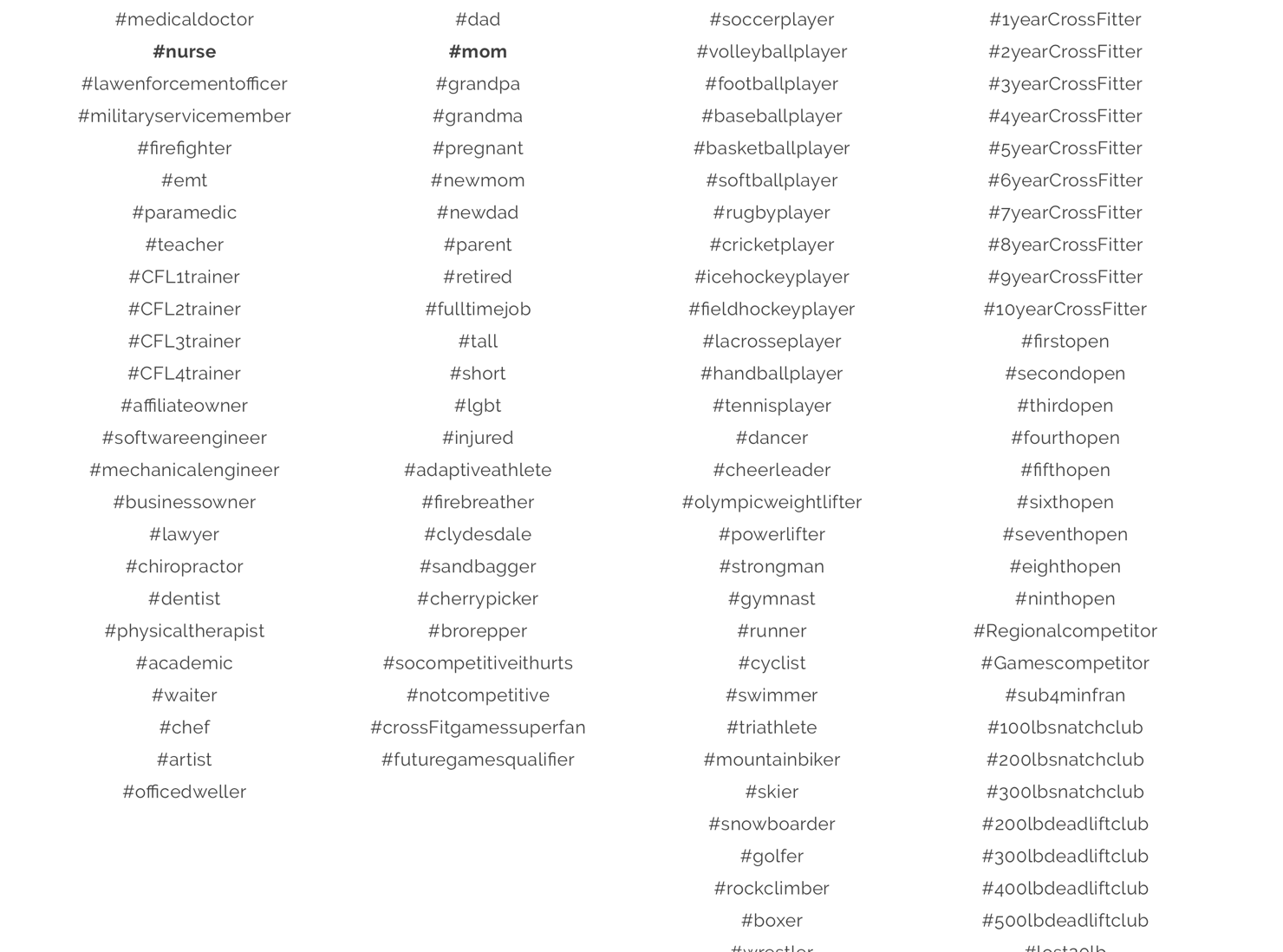
Initial list of hashtag suggestions, grouped into categories as a starting point for UI exploration.
Throughout, the UI maintained the look and feel of the CrossFit Games design system, so the wizard felt like a natural extension of the existing Open experience instead of a bolt-on tool.
Prototyping, Testing & Category Badges
I explored multiple layout approaches, from simple static lists to more advanced, interactive components. Flows were designed in Sketch and tested via InVision, giving stakeholders an easy way to click through and comment on interactions.
To visually anchor each category, I created badge icons that mirrored the material-inspired look of the Open marketing art for that year.

Hashtag category badges that aligned with the 2019 CrossFit Open visual language.
Early designs surfaced a key problem: athletes might not realize that suggested hashtags were interactive. To address this, I moved toward a more “clickable” pattern — turning suggestions into enclosed chips that looked distinct from primary action buttons.
Each chip also needed to be removable once selected, so we added a clear removal affordance to the left of the label.
Managing Complexity with Layout & Interaction
Stakeholders strongly preferred including as many suggested identifiers as possible, which was at odds with the goal of keeping the experience approachable.
To balance both, I explored:
- A tabbed layout, where each tab represented a category
- “Load more” interactions within each tab to avoid overwhelming the initial view
- Step-based flows that separated suggestions, custom creation, and leaderboard integration
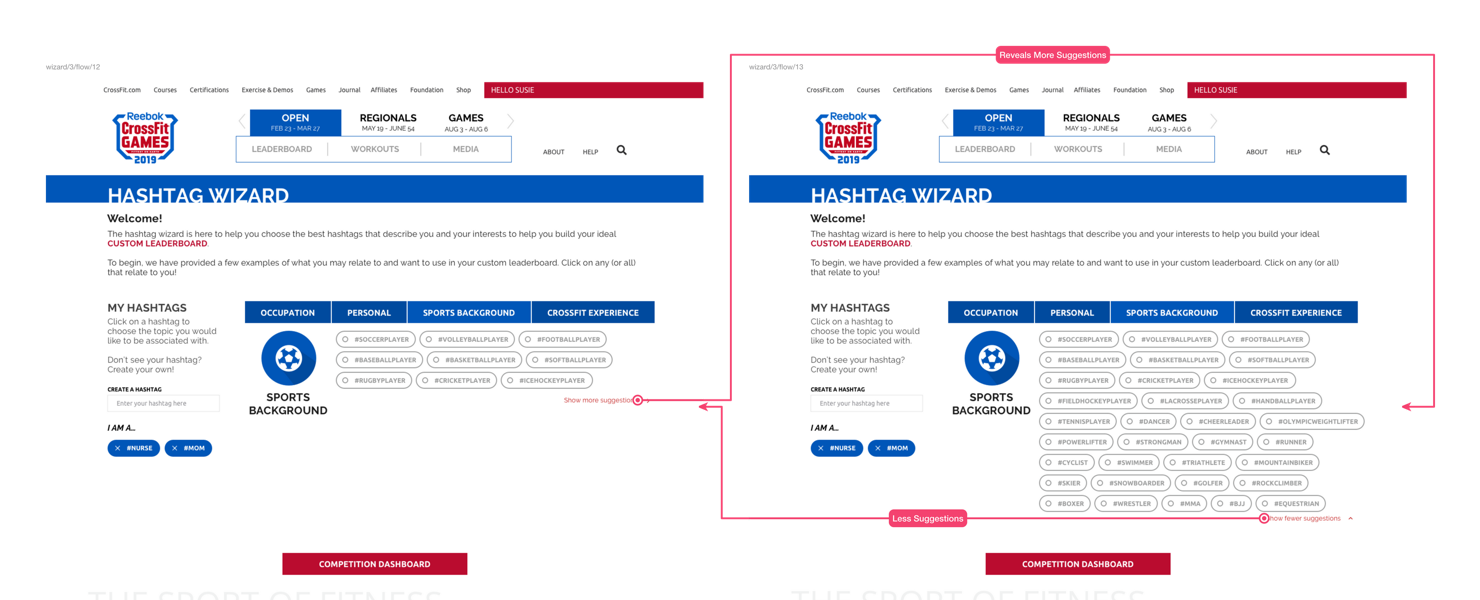
Tabbed layout exploration with reveal patterns to handle larger lists of hashtag suggestions.
Another exploration presented all categories on a single page, moving athletes through:
- Choosing from curated hashtag suggestions
- Adding their own custom hashtags
- Seeing how those tags feed into Custom Leaderboards
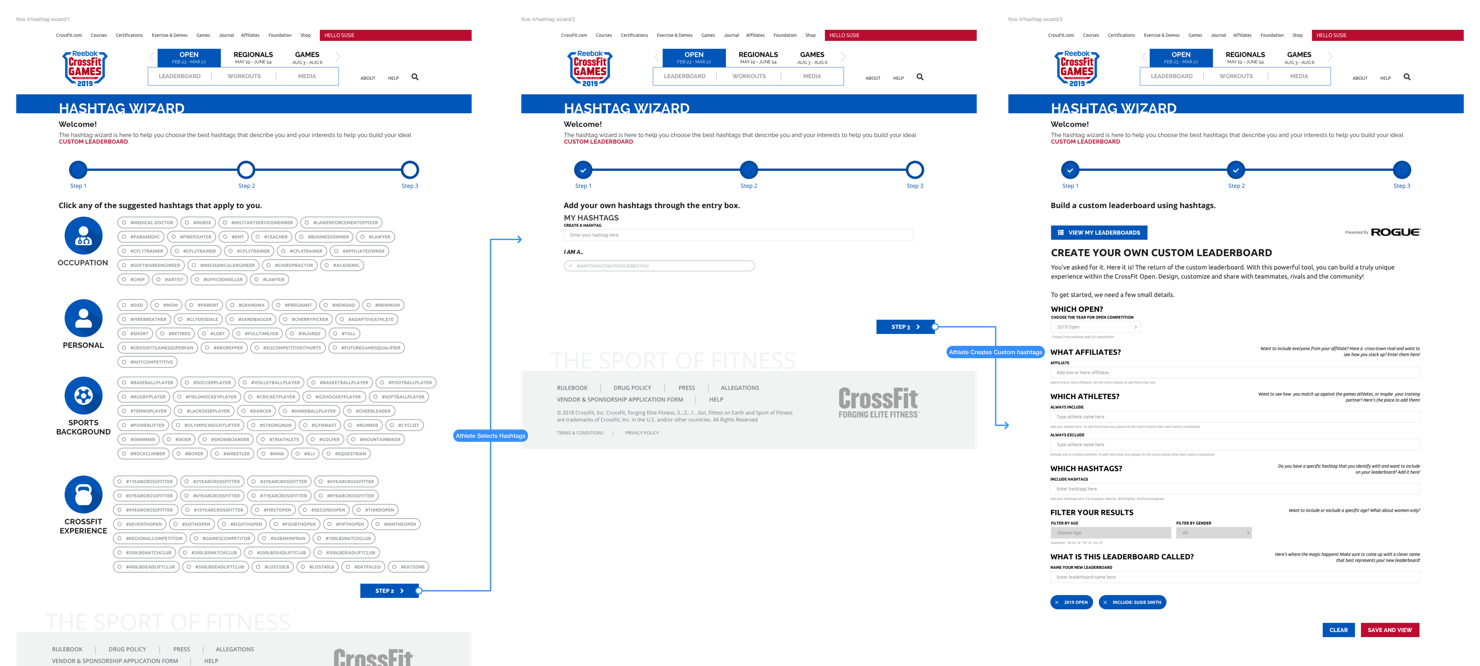
Layout exploration showing a guided, step-by-step flow from suggestions to custom hashtags.
Through A/B testing at HQ and with a select group of athletes, we validated that a simplified approach with fewer suggestions per category was more usable and less cognitively heavy.
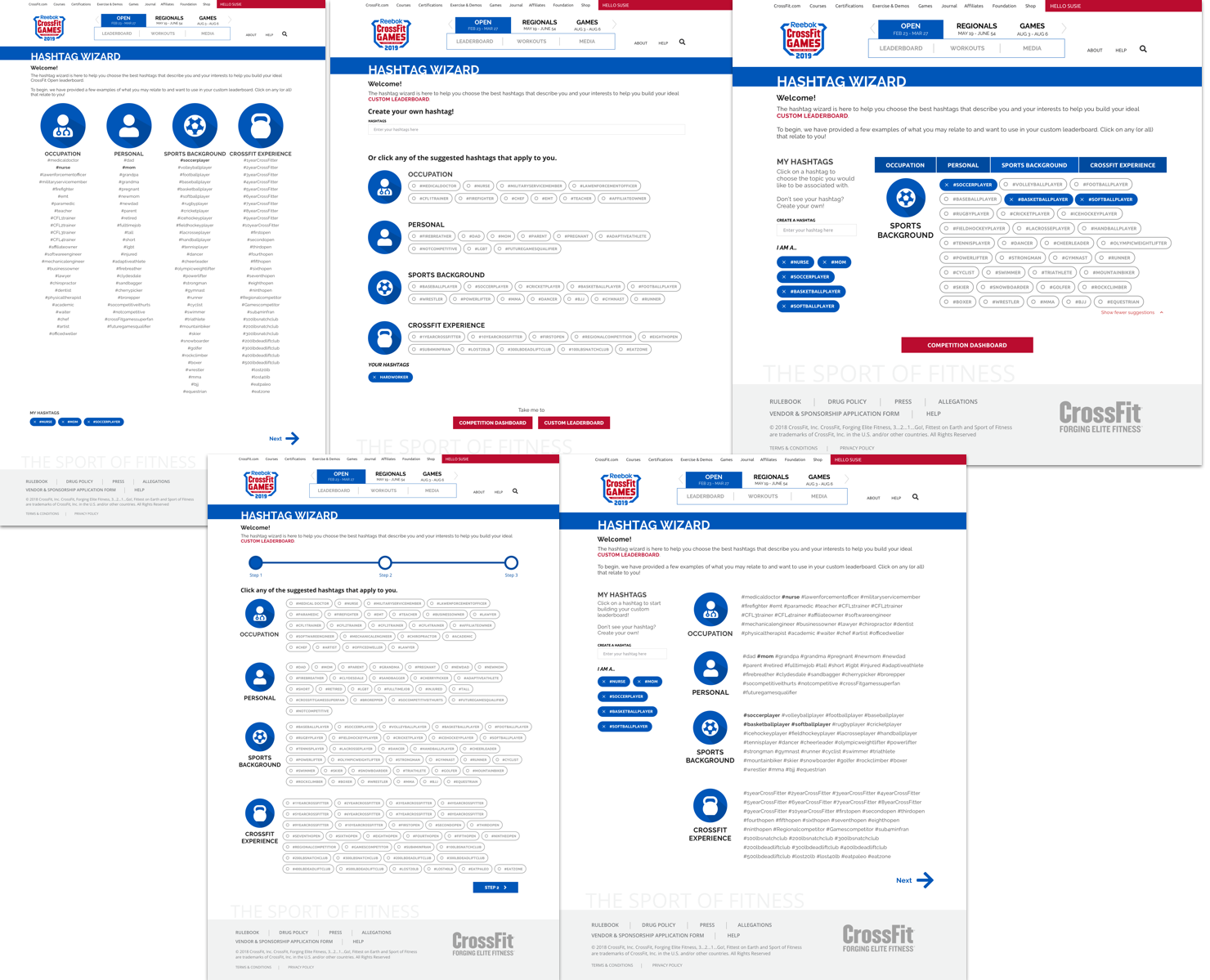
Desktop layout explorations and iterations as the final flow was refined and aligned with Custom Leaderboards.
The final layout was integrated with the approved flow for the new Custom Leaderboard, ensuring both features launched together as part of a cohesive 2019 Open experience.
Outcome
The Hashtag Wizard shipped in January 2019 alongside the Custom Leaderboard, in time for the CrossFit Open.
It became a key way for athletes to personalize their Open experience — tagging themselves, discovering others with similar identifiers, and surfacing those connections inside Custom Leaderboards.
The feature was supported with launch video content and simple how-to guides to help athletes quickly understand the value of hashtags.
You can view the Hashtag Wizard at games.crossfit.com .
Conclusion
The Hashtag Wizard extended the CrossFit Games leaderboard beyond fixed filters, giving athletes a way to see themselves — and others — through more personal lenses.
This project highlights my ability to:
- Translate a loosely defined idea (“hashtags would be cool”) into a concrete, testable flow
- Balance stakeholder desires with UX clarity and cognitive load
- Design cohesive experiences that tie together multiple feature launches
Paired with the Custom Leaderboard and other leaderboard work, the Hashtag Wizard helped push the CrossFit Open experience toward something more personal, playful, and community-driven.