Case Study · Product Design · Multi-Mode Display System

btwb Workout TV — Bringing Real-Time Training to the Gym Space

A multi-mode performance display that integrates with the BTWB platform to support coaches, motivate athletes, and visualize live workout and performance data.
Role

Lead Product Designer

Led visual, interaction, and behavioral evolution of Workout TV across multiple generations, ensuring continuity with earlier versions while supporting a modern, intuitive multi-mode design system.

Scope

In-Gym Displays → Integrated Platform

Designed multi-mode layouts, Tempus-integrated pacing screens, PR celebration modes, and fully customizable WOD displays aligned with the broader BTWB ecosystem.

Outcome

A Familiar Yet Modern Experience

Delivered a refined, flexible display system that feels natural to long-time WODscreen users while meeting the needs of gyms adopting the All-In-One platform for the first time.

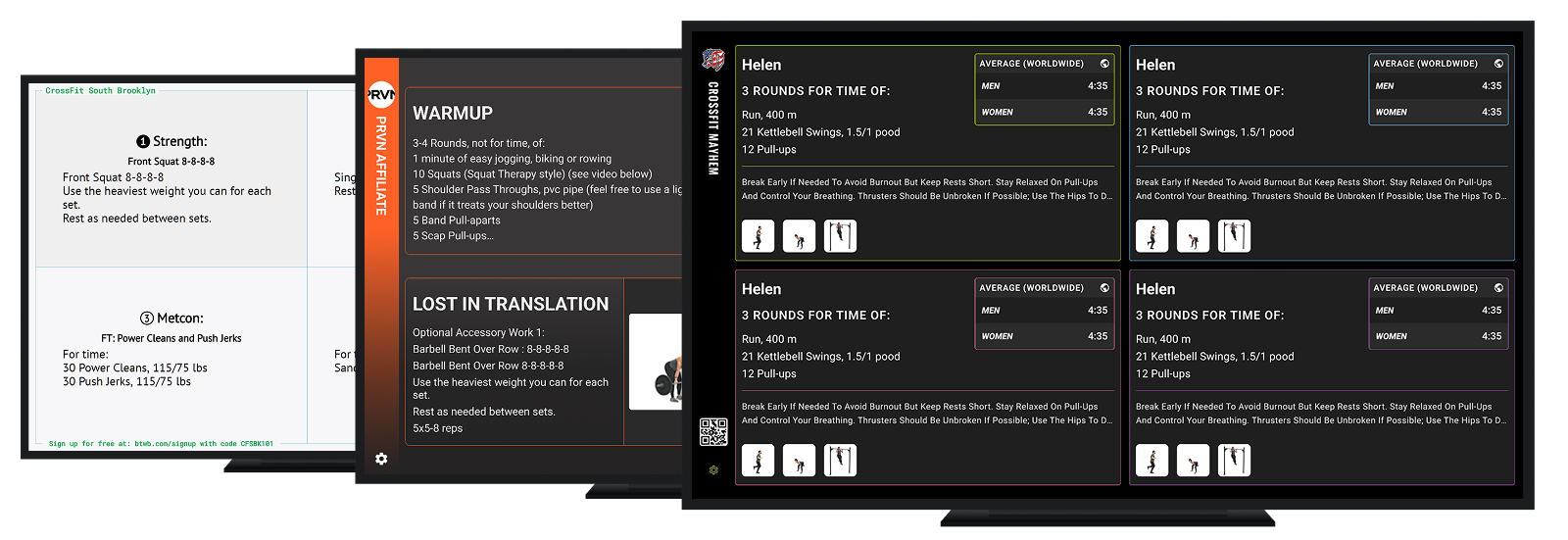
Workout TV multi-mode display on large gym screens

Workout TV displaying multi-mode workout and performance visuals inside a training space.

Overview

In gyms, the big screen on the wall isn't just a display—it's the most visible touchpoint in the facility. It's what athletes look at during workouts, what coaches reference when leading class, and what creates the shared experience that builds community.

When I first joined BTWB in 2018 as a freelancer, gym displays were exactly that—static, limited tools. I redesigned the original WODscreen, bringing clarity and improved hierarchy to gym spaces. When I rejoined full-time in 2022, Workout TV became a core design surface for BTWB's evolving ecosystem.

By 2025, we had transformed it into a dynamic platform that:

The 2025 release delivered the strongest, most cohesive version to date — unifying experience, visuals, and functionality across the entire BTWB ecosystem.


Problem & Opportunity

Before the 2025 overhaul, WODscreen (the earlier version of Workout TV) served gyms well but was limited:

Gyms needed something more dynamic — a display that:

Old WODscreen design compared to new Workout TV multi-mode interface

Workout TV evolved from a simple WOD display into a fully integrated visual layer for training environments.


My Role: Lead Product Designer

I was the sole designer on Workout TV throughout its evolution from 2018 to 2025, owning the complete design lifecycle across four major releases:

The challenge was unique: every iteration needed to respect the mental models of gyms who had used WODscreen for years while making the product dramatically more flexible and modern for new users.

Early Foundations (2018)

Freelance redesign Clearer WOD hierarchy Improved legibility

Reassessment & Planning (2022)

Full-time return Audit of WODscreen Platform alignment

UX & UI Improvements (2022–2024)

Visual refinements Performance updates User feedback loops

Feature Integration (Tempus)

Live pacing Real-time reps Class-wide visibility

Platform Alignment (2025)

New multi-mode system Customization controls Unified visual language

Design Consistency

  • Ensured visual and functional alignment across generations of the product.
  • Modernized layouts while preserving familiarity for long-time users.
  • Unified spacing, typography, and component patterns with BTWB ecosystem.

Stakeholder Alignment

  • Collaborated closely with founders, PMs, and coaching advisors.
  • Identified feature priorities and platform dependencies.
  • Balanced business goals with user expectations.

Execution & Delivery

  • Created UI, interaction patterns, and high-fidelity prototypes.
  • Prepared dev-ready specifications for new modes and integrations.
  • Maintained quality through implementation reviews and iteration.

Five Display Modes for Any Class, Any Goal

Workout TV includes four distinct display modes, each designed for a different moment in the training experience. Gyms can swap modes instantly, customize details, and cast wirelessly with a single tap.

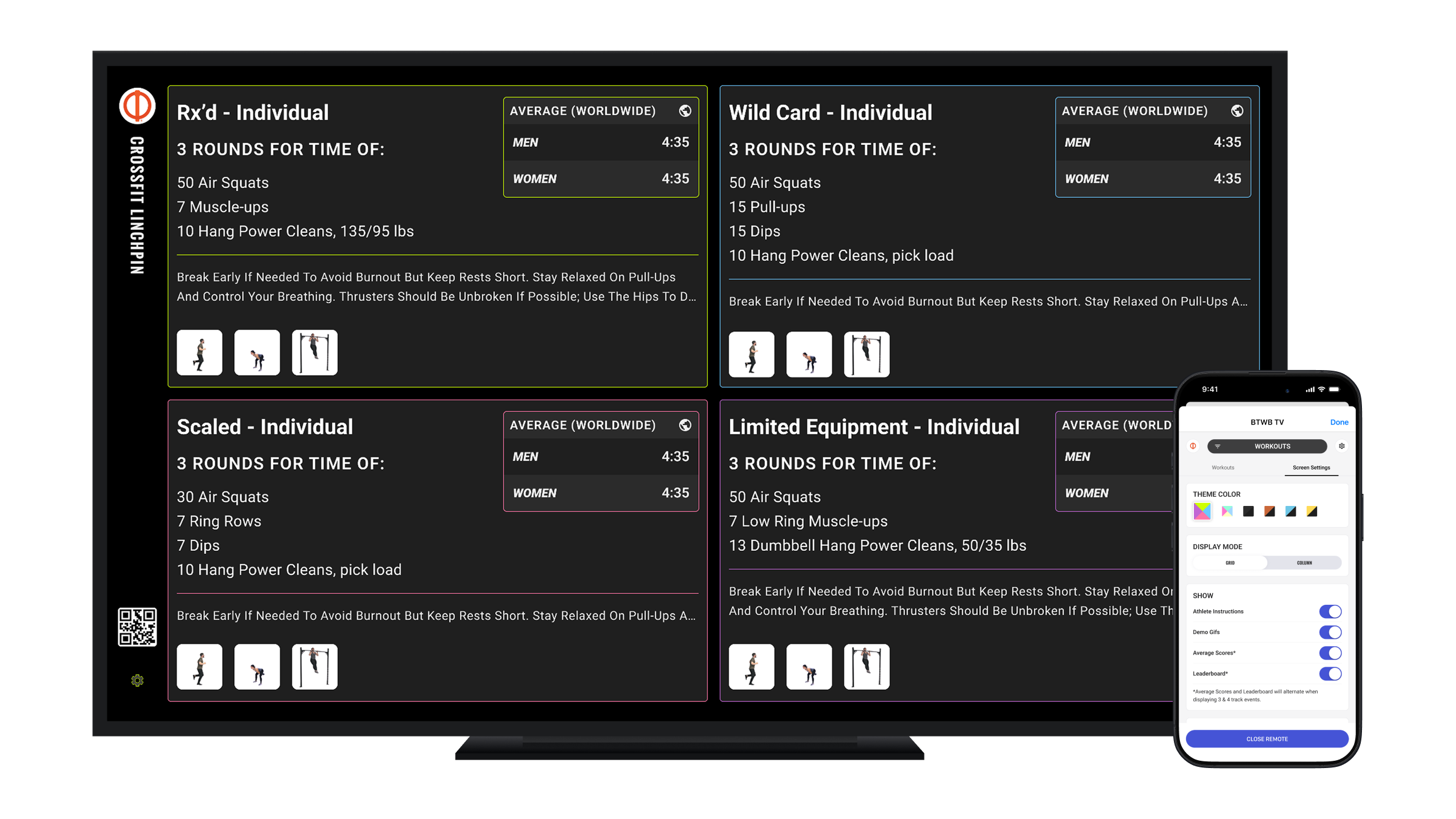
Workout TV WOD display

1. Workout View

The classic WODscreen — clearer, modernized, and customizable. Supports multiple WODs, movement demos, scaling notes, and flexible text sizing.

PR celebration mode

2. PR & Celebration View

Automatically highlights newly earned PRs, badges, and milestones. Designed to build community and reinforce consistency.

Leaderboard display

3. Leaderboard View

Displays athlete results after class, surfacing effort, pacing, and performance across athletes.

Tempus real-time pacing mode

4. Tempus Pacing View

A competitive, real-time view for workouts tracked via Tempus. Shows pacing, live reps, heart rate zones (when supported), and athlete position.


Tempus Integration: Bringing Live Data Into the Gym Space

When BTWB introduced Tempus — a competitive, real-time workout experience — Workout TV became the natural display layer for bringing that pacing, intensity, and energy into the physical gym environment.

Tempus real-time view displayed on Workout TV

Tempus mode enhances the training atmosphere by visualizing pacing and performance in real time.

This integration strengthened BTWB’s “fitness-first” positioning and brought meaningful coaching insights directly into class flow.


Design Decisions & UI Evolution

Workout TV spanned multiple generations and design eras — which meant every update needed to respect existing mental models while leveling up clarity, visual polish, and functionality. My responsibility was to create a product that felt familiar to long-time users but unquestionably modern and intuitive for new gyms adopting BTWB’s ecosystem.

The evolution below reflects visual, structural, and functional progress from early 2018 redesigns through the 2025 platform-aligned release.

Key Design Decisions

Decision 1

Preserve Familiarity, Modernize Everything Else

Long-time BTWB gyms relied on recognizable WOD layouts and color-coding conventions they'd been using since 2018. The challenge was modernizing visuals, spacing, and hierarchy without breaking the mental models that made coaches efficient during fast-paced classes.

The 2025 design system introduced:

  • Improved contrast and scalable spacing aligned with BTWB's product-wide visual language
  • Refined typography hierarchy that stayed readable from anywhere in the gym
  • The same core WOD structure, instantly recognizable to veteran users

This decision allowed us to ship a major visual overhaul while receiving feedback like "it feels like WODscreen, but way better"—exactly what we wanted.

Decision 2

Customization Needed to Scale Across Gym Spaces

Gyms vary dramatically — lighting, space, distance from screens, and display sizes all differ. Users needed control over colors, text size, and number of WODs shown. Workout TV introduced lightweight customization that kept the UI structured while giving owners flexibility to adapt to their environment.

Decision 3

Integrate Real-Time Data Without Creating Visual Chaos

Tempus brings fast, dynamic workout data—pacing updates, rep counts, positional comparisons, and heart rate zones. The display design had to support this movement without overwhelming athletes or creating noise during class.

We focused on:

  • Clean, predictable motion and structured grids so updates felt natural, not jarring
  • Pacing visuals that were exciting but never distracting—designed to motivate, not stress
  • Information hierarchy that surfaced what mattered most at each moment in a workout

This integration became one of BTWB's key differentiators. Competitors offered live tracking or gym displays—we offered both, seamlessly connected. The design made that feel effortless.


Constraints & Tradeoffs

Not every idea made it into the product, and that was intentional. Here are a few things we deliberately chose not to pursue:

UI Evolution Over Time

Workout TV’s evolution mirrors BTWB’s broader transformation — from a simple WOD display to a connected, dynamic, data-informed training experience. Below is a high-level visual progression.

Early 2018 redesign of WODscreen

2018: Freelance redesign introducing clarity and hierarchy improvements.

2022 refinements and system alignment

2022: Foundation adjustments and alignment with BTWB's updated product surfaces.

Display designs with Tempus integration

2023–2024: Tempus pacing and competitive display modes added.

Full 2025 overhaul with multi-mode layout

2025: Full multi-mode system aligned with BTWB's All-In-One platform.


Shipped Outcomes & Impact

Rather than iterate in isolation, each release built toward a cohesive platform vision — here's the impact:

Outcome 1

Expanded Product Reach Beyond Gyms

Workout TV became BTWB's first gym-facing product available to individual users. Home athletes training in garage gyms could now access the same display experience as commercial facilities—opening a new use case we'd never supported before.

Outcome 2

Created a Unified, Cross-Platform Experience

By aligning Workout TV's visual language with BTWB's mobile app, Gym Management, Plan, and Tempus, users experienced consistency across every touchpoint. Long-time users immediately recognized the interface, while new gyms found it intuitive and familiar to the rest of the platform.

Outcome 3

Made Customization Scalable Across Gym Sizes

Gyms vary dramatically—from 20-person garage boxes to 200-member facilities with multiple screens. The customization system I designed gave gym owners control over colors, layout density, text sizing, and displayed elements so the same product worked beautifully everywhere from 32" TVs to 70" displays.

Outcome 4

Turned a Static Display Into a Live, Engaging Tool

With Tempus integration, the display evolved from "here's today's workout" to "here's who's working out right now and how they're performing." Real-time pacing indicators, live leaderboards, PR celebrations, and check-in visualizations transformed the screen into the heartbeat of the class.

The 2025 release represented the culmination of this work—a modern, flexible, deeply integrated display that supported coaches, motivated athletes, and reinforced BTWB's positioning as the platform that puts fitness and results first.


Reflections

Designing Workout TV over seven years taught me a few things that have shaped how I approach product work:

  1. Evolutionary design can be just as impactful as revolutionary design

    We didn't reinvent the display experience in one big launch. We iterated generation by generation, each time making it more flexible, more aligned, and more powerful. That patience paid off—long-time users stayed engaged while new users found it modern and polished.
  2. Consistency across a platform requires constant negotiation

    Aligning Workout TV with BTWB's broader design language meant coordinating with multiple product surfaces, each with different constraints. I learned to be a strong advocate for visual cohesion while respecting what made each product unique.
  3. Designing for visibility at scale is a different discipline

    Every decision—contrast, font size, spacing, motion—had to account for viewing distance, screen size, and ambient lighting. This forced me to think beyond what looked good on my monitor and design for real-world gym environments.
  4. Early stakeholder alignment prevents late-stage redesigns

    Working closely with gym owners, coaches, and athletes from the beginning helped us avoid building features nobody needed. The feedback loops we established in 2018 paid dividends through 2025—we rarely had to backtrack on major decisions because we validated early and often.

If I were starting this project today, I'd invest earlier in a structured design system and component library. Much of the consistency we achieved by 2025 was hard-won through repeated refinement. A solid foundation earlier would have made iteration faster and more sustainable.