Case Study · Product Design · 0→1 Platform

Building BTWB Gym Management — Designing the First All-In-One Platform for Functional Fitness Gyms

A unified system that brings scheduling, billing, check-ins, and workout tracking together to streamline gym operations and elevate the member experience.
Role

Lead Product Designer

Owned end-to-end UX, UI, and design systems for a multi-year 0→1 product spanning web admin, member app, and in-gym displays.

Scope

Gym Operations → Fitness Platform

From core billing, memberships, and check-ins to ecosystem integrations and fitness-centric features like Committed Club and Year-in-Review.

Outcome

One Hub, Less Overhead

Helped gyms consolidate 3–5 legacy tools into a single platform, reducing software overhead and improving day-to-day workflows for owners, coaches, and athletes.

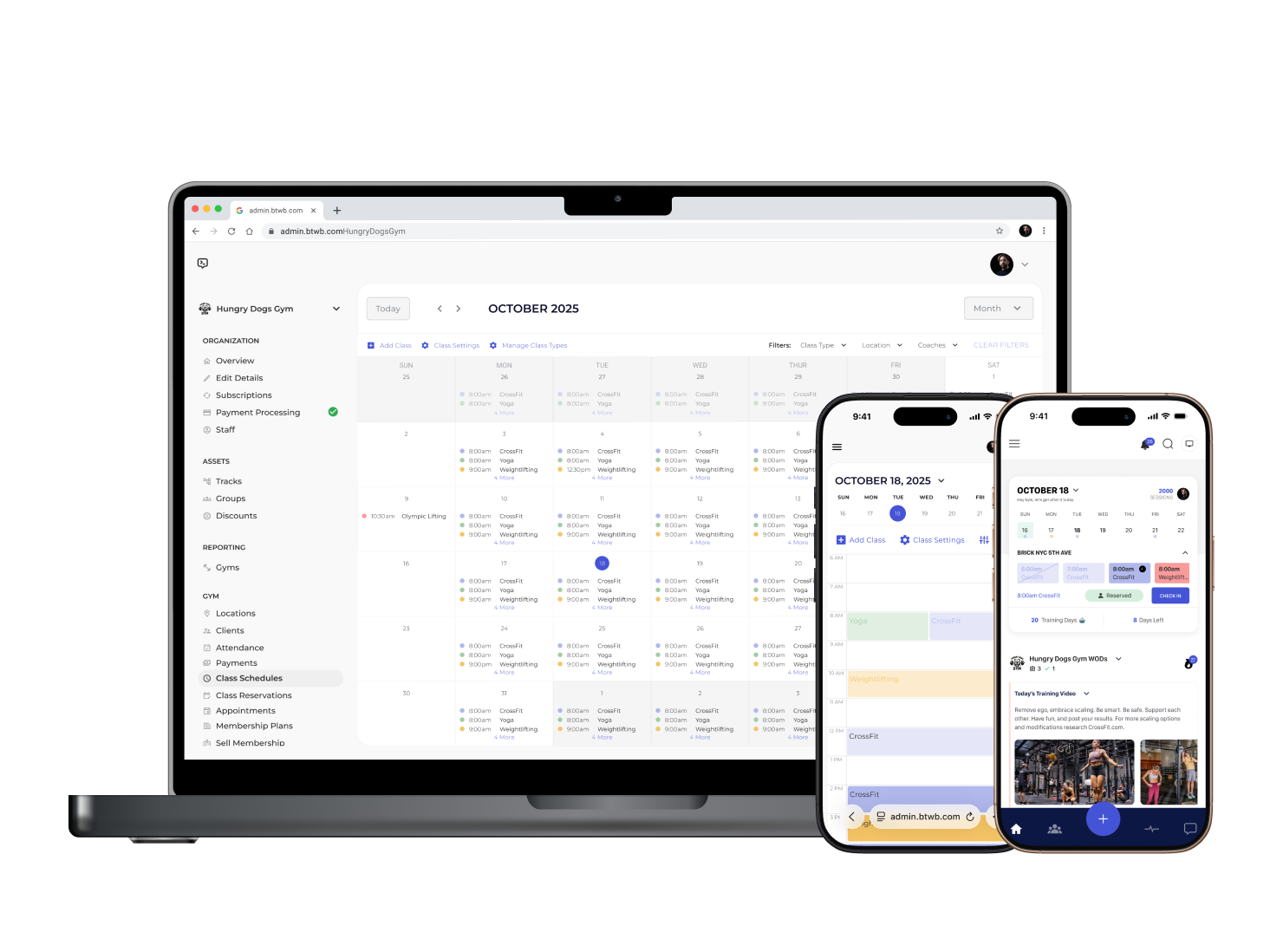
BTWB Gym Management hero mockup with laptop and mobile screens

Hero view of the BTWB Gym Management platform across web and mobile.

Overview

Over a two-year 0→1 initiative, I led the end-to-end design of Beyond the Whiteboard’s Gym Management platform, transforming the product ecosystem from a workout-tracking app into a fully integrated operational system for functional fitness and CrossFit gyms.

This case study highlights my ownership, domain expertise, and the impact of the shipped work.

Role & Impact

Lead Product Designer

Designed the UI, interactions, visuals, and UX strategy that enabled smooth, successful conversions for gyms switching from other management platforms to BTWB.

Platform Evolution

Zero to One

Greenfield Project MVP Launch

Built the foundational design system and core architecture from a blank canvas to a fully scalable SaaS platform.

Tool Consolidation

Unified Workflow

Legacy 4 Tools
New Platform 1 Hub

Problem & Opportunity

Most gyms used BTWB for workout tracking but were forced to juggle 3–5 other tools for their daily operations — billing, check-ins, scheduling, POS, and client management. The fragmented experience created:

We identified an opportunity to consolidate all of this into one platform, built around the strengths and needs of functional fitness gyms.
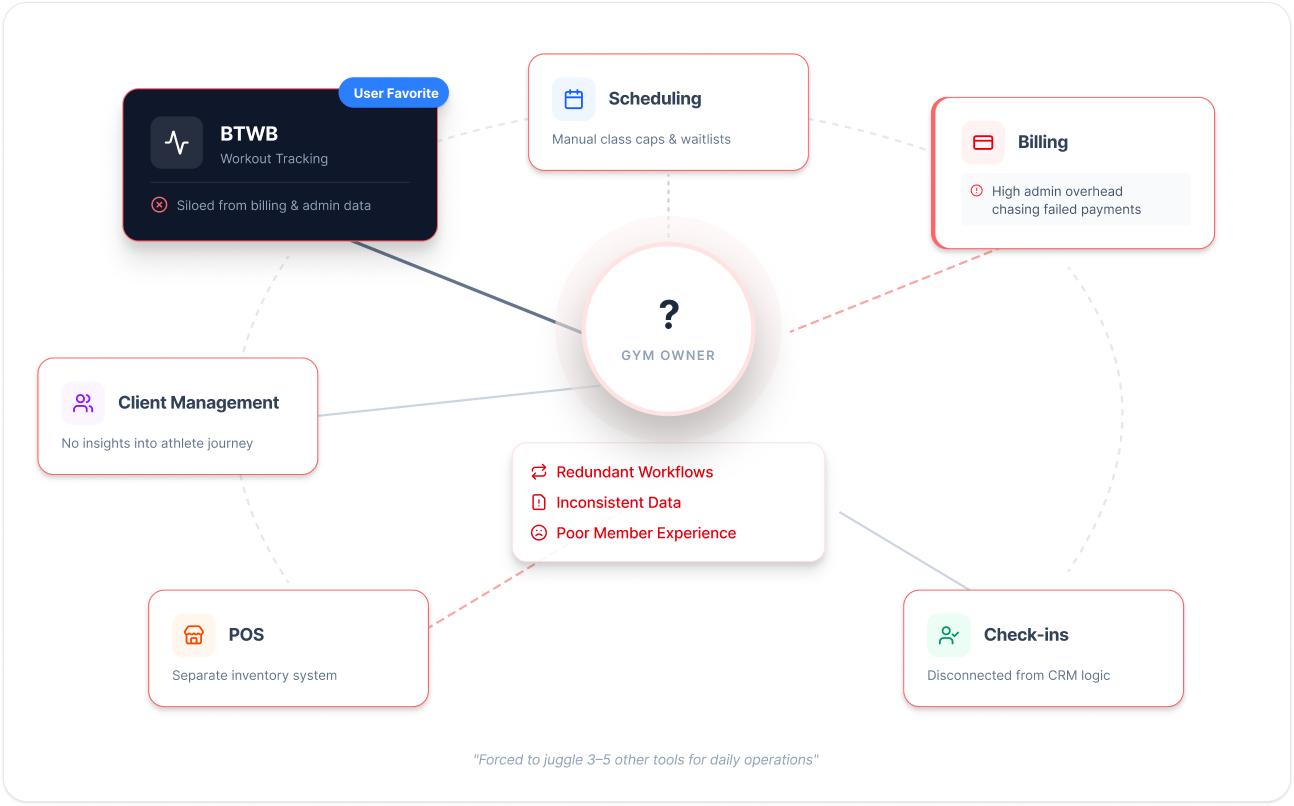
Fragmented tool stack across billing, scheduling, check-ins, POS, and workout tracking

Before: a fragmented tool stack across billing, scheduling, check-ins, POS, and workout tracking.


Research & Domain Understanding

This project demanded more than UI work — it required deep understanding of how gyms actually operate. I led the user research effort, partnering with a trusted group of long-time BTWB gym owners. Together, we mapped:

The Gym Owner

Decision Maker

"I need to stop acting as IT support and start coaching. My systems need to talk to each other."

Retention Revenue Efficiency

The Head Coach

Power User

"I want to know who's in class and what their PRs are before they even walk in the door."

Programming Athlete Safety

The Athlete

End User

"I just want to sign my waiver, pay my bill, and log my score without checking 3 different apps."

Community Progress
Research Insights & Needs

Operational Needs

Simple Membership Mgmt

Owners spend too much time fixing billing errors. Needs to be "set and forget".

Waivers & Onboarding

Must happen digitally before they step on the floor. No paper clutter.

Flexibility

"Pausing memberships needs to be one click, not a support ticket."

Fitness Outcomes

Unified Data Ecosystem

Programming ↔ Check-ins ↔ Results. If a member PRs, the system should know.

Coach Visibility

"I need to see athlete ability levels on the class roster to scale workouts appropriately."

Celebration

Milestones, Committed Club, Year-in-Review. Celebrate consistency automatically.

This research directly anchored our roadmap: we prioritized foundational operations first, then layered in fitness-centric features impossible with disconnected systems.

This demonstrated deep domain understanding — not just how gyms look, but how they run, make money, retain members, and coach effectively.


Design Decisions & UI Evolution

With constraints and domain context understood, the next step was turning that into a product that felt coherent across surfaces, calm for daily operators, and trustworthy around billing and memberships.

Constraints & Tradeoffs

  • Gyms were already using 3–5 tools for billing, check-ins, and scheduling — migration couldn’t disrupt cash flow or classes.
  • We needed to ship in phases, sequencing core operations first and layering integrations and fitness features later.
  • Gym business models varied (class-only, open gym, hybrid, punch cards), so the system had to be flexible without becoming a settings maze.
  • The team was small and distributed, which meant design had to make implementation simpler, not more complex.

Design Principles

  • Operations follow the workout. Organize the system around classes and training, not generic CRM objects.
  • One source of truth. Check-ins, billing, and workout results all point to the same member profile.
  • Low cognitive load. Owners should manage memberships and edge cases through a few clear patterns.
  • Fitness-first, not admin-first. Every operational flow should enable better coaching, not just better bookkeeping.
Gym Management navigation and layout showing classes as the primary organizing object

Decision 1

Anchor the IA Around Classes

Early explorations split the product into separate billing, people, and schedule sections. Gym owners kept gravitating back to one question: “What’s happening in class today?” We re-centered the IA around classes as the primary object — each class became the hub for rosters, memberships, waivers, and performance history. This matched how coaches and owners think about their day and reduced navigation hops for core tasks.

Before and after onboarding flow diagram showing reduced steps from a multi-step external checkout to a simple three-step in-product setup

Decision 2

Streamline Onboarding Without Adding Friction

The original onboarding asked new gyms to complete a long sequence before they could even explore the product: create an account or log in, create an organization, choose a subscription, go to a separate Stripe checkout, configure payment processing, and then finally add a gym location. We collapsed this into a three-step pathcreate account → create organization → add gym — and moved subscription and payment setup into focused flows inside the app. This cut the perceived setup cost, reduced drop-off risk, and helped owners reach an “I can actually use this” moment much faster, without sacrificing clarity or control over billing.

Consistent visual language across web admin, member app, and in-gym displays

Decision 3

Use One Visual Language Across Surfaces

A shared typography scale, spacing system, and component set shows up in web admin, the member app, and in-gym displays. This makes the platform feel like a single ecosystem instead of disconnected tools, and lets the team ship new features across surfaces without re-solving visual decisions each time.


My Role: End-to-End Ownership

From concept to release, I acted as the Lead Product Designer, owning the full design lifecycle across all product surfaces.

Discovery

User Interviews Requirements Gathering Roadmap Shaping

Definition

Service Mapping Flow Creation Owner Needs Analysis

Design

UI & Interaction Design Systems Prototyping

Build

Dev Documentation QA Review Engineering Alignment

Launch

Release Feedback Loops Post-launch Iteration

Strategic Ownership

  • Defined design direction for the entire Gym Management ecosystem.
  • Partnered with PMs and stakeholders to shape the roadmap.
  • Represented gym owner needs in product decisions.

End-to-End Execution

  • Service mapping & flow creation from low to high fidelity.
  • UI design, interaction patterns, and design systems.
  • Created dev-ready documentation and managed QA reviews.

Leadership

  • Daily alignment with PMs, offshore engineering, and QA.
  • Ensured design consistency across BTWB app, Plan, and Workout TV.
  • Facilitated rapid iteration and continuous feedback loops.

Execution: From Operations to Fitness-First Platform

We didn’t ship Gym Management as a single “big bang” release. Instead, we built in three tightly scoped phases — first stabilizing core operations, then connecting the platform across BTWB, and finally unlocking fitness-first features that only a unified system could support.

Phase 1 Operations Foundation

Core Operations

Ship the must-haves first: give owners a reliable, modern backbone for running the gym day to day.

  • Scheduling and class management for daily operations.
  • Check-ins and rosters tied directly to memberships.
  • Memberships, waivers, and basic admin tools built for “set and forget.”

Outcome: Replaced a patchwork of legacy tools with a single, dependable system for running the business.

Phase 2 Ecosystem Integration

Platform Integration

Once core operations were stable, we focused on connecting Gym Management into the rest of BTWB.

  • Integrated with the BTWB app for bookings and check-ins.
  • Connected to Plan (programming) so classes reflected live workouts.
  • Tied into Workout TV for in-gym visibility and class flow.

Outcome: Members and coaches experienced one coherent system instead of separate apps stitched together.

Phase 3 Fitness Layer

Fitness-Centric Features

With operations and integrations in place, we could design features that made the gym feel more intelligent, personal, and motivating.

  • Class screens that celebrate milestones and consistency.
  • Pre-class coach intel tied to check-ins and performance history.
  • Committed Club, Year-in-Review, and other “Fitness Wrapped” experiences.

Outcome: Gym Management became more than admin software — it became a platform for coaching, community, and long-term engagement.

Selected Screens from Each Phase

Admin dashboard UI showing core operations for Gym Management

Phase 1: Core operations — scheduling, memberships, waivers, and daily admin in one place.

Screens showing integrations between Gym Management, BTWB app, Plan, and Workout TV

Phase 2: Connecting Gym Management into the broader BTWB ecosystem.

UI for milestones, committed club, and year in review features

Phase 3: Fitness-first features built on top of the new unified platform.


Shipped Outcomes & Measurable Impact

While the project was not framed around proving strict business metrics, the shipped work clearly changed how gyms run on BTWB — from tool consolidation to member experience and coaching quality.

Outcome 1

Rapid Adoption & Tool Consolidation

Gyms already using BTWB began adopting Gym Management quickly — far faster than is typical for gym software. Many consolidated 3–5 external tools into a single platform, reducing operational overhead and simplifying their tech stack.

Outcome 2

Dramatically Improved Member Experience

Members moved from juggling multiple logins to using a single app for workouts, class reservations, and check-ins. Progress, milestones, and badges live in one place, making the experience feel cohesive and more rewarding.

Outcome 3

Elevated Coaching Quality

Coaches gained pre-class intel, integrated performance history, and balance-aware programming tools. Instead of piecing together information across systems, they could see readiness, risk, and opportunity from a single view.

Outcome 4

Reduced Owner Workload

Gym owners reported less admin work, fewer workflow gaps, and more confidence in their data. With attendance, retention, and performance visible in one place, they could spend more time coaching and less time troubleshooting software.

Outcome 5

Strong Community Praise & Global Reach

Feedback from the BTWB community was consistently strong, with high engagement on new features and growing international adoption across 26+ countries. Even without formal analytics, ongoing investment in the platform reflected its impact.


Conclusion

This project represents a major expansion of the BTWB ecosystem — one that unified previously scattered gym operations into a single, fitness-first platform.

As Lead Designer, I drove the vision, strategy, design, and daily execution across a multi-year 0→1 build. I developed deep domain understanding, collaborated closely with owners and cross-functional partners, and shipped features that delivered meaningful impact on gym workflows, member engagement, and community adoption.

This case study showcases my ability to: